
SAP Table T001B
Permitted Posting Periods
What Is the SAP T001B Table?
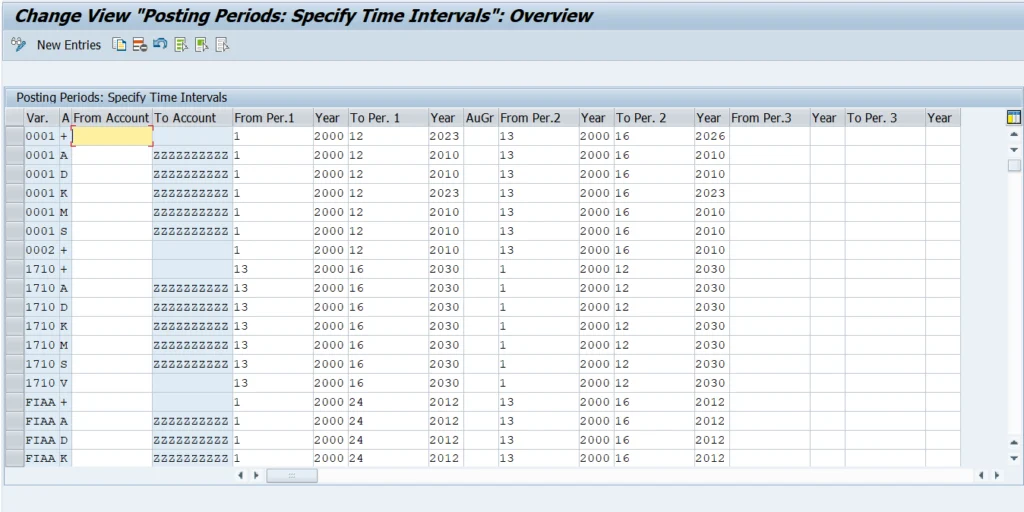
SAP T001B table stores permitted posting period settings used in SAP Financial Accounting. It controls which accounting period are open or closed for postings, based on the posting period variant, account type, time intervals and fiscal year.
When posting periods are open or closed using transaction code OB52, the permitted posting period settings are updated in the T001B table.
In production SAP system, normally the current accounting period is kept for day-to-day postings, while other periods are remain closed. During month-end or year-end activities, previous period or special periods can also be open when required for accounts adjustment.
T001B table allows posting periods to be controlled for different account types:
- + – All Account types
- A – Assets
- D – Customers
- K – Vendors
- M – Materials
- S – G/L Accounts
For example:
- Assume Company Code: 1010
- Posting Period Variant: P001
- Posting Date: 01.10.2026
- Fiscal year: January to December
When a vendor invoice is posted using transaction code FB60 with a posting date 01.10.2026, SAP determines the posting period based on posting date and fiscal year variant.
Since the fiscal year follows January to December, the posting data 01.10.2026 corresponds to posting period 10 and Fiscal year 2026
The system check the permitted posting period settings maintained in T001B for the posting period variant P001.
If period 10/2026 is open for the required account type, SAP allows the vendor invoice to be posted. If posting period is closed, the system prevents the posting and displays a posting period related error message as posting period was not opened.
SAP Consultants, users & support team uses T001B table to check open and close posting periods, verify special-periods, analyze account type and account range restrictions and troubleshoot posting period related errors.
Quick overview
| SAP table | T001B |
|---|---|
| Short description | Permitted Posting Periods |
| Table type | Transparent table |
| Primary key | MANDT (Client), RRCTY (Record Type), BUKRS (Posting Period Variant), MKOAR (Account Type or Masking), BKONT (To Account) |
| Client-dependent | Yes |
Important fields explained
| Field | SAP field description | What this field means |
|---|---|---|
BUKRS |
Posting Period Variant | Posting Period varaint identifies the set if rules used to open and close posting periods |
MKOAR |
Account Type or Masking | Accoun type or masking used to control posting perods for specific account types such as G/L, Asset, customer, vendor, and material accounts |
VKONT |
From Account | From Account that identifies starting account of the account interval for which posting period rule applies |
BKONT |
To Account | To account that identifies the upper limit of the account interval for which posting period rule applies |
FRYE1 |
Fiscal Year for First Period Allowed (in Interval 1) | From Fiscal Year from which the first posting period interval is valid |
At a glance
- Module
- Financial Accounting FI
Technical details
- Delivery class
- C (Customizing, maintenance only by customer, no SAP imports)
- Data class
- APPL2 (Organization and customizing)
- Package
- Financial Accounting "Basis" (FBAS)
Primary key fields
| Field | Description | Data element | Type | Length |
|---|---|---|---|---|
MANDT
|
Client | MANDT | CLNT | 3 |
RRCTY
|
Record Type | RRCTY | CHAR | 1 |
BUKRS
|
Posting Period Variant | OPVAR | CHAR | 4 |
MKOAR
|
Account Type or Masking | MKOAR | CHAR | 1 |
BKONT
|
To Account | BKONT_001B | CHAR | 10 |
Table fields
19 fields
19 fields
| Field | Description | Data element | Domain | Type | Length | Decimals | Check table |
|---|---|---|---|---|---|---|---|
MANDT
Key
|
Client | MANDT | MANDT | CLNT | 3 | — | T000 |
RRCTY
Key
|
Record Type | RRCTY | RRCTY | CHAR | 1 | — | |
BUKRS
Key
|
Posting Period Variant | OPVAR | OPVAR | CHAR | 4 | — | T010O |
MKOAR
Key
|
Account Type or Masking | MKOAR | MKOAR | CHAR | 1 | — | |
BKONT
Key
|
To Account | BKONT_001B | MAXKN | CHAR | 10 | — | |
VKONT
|
From Account | VKONT_001B | MAXKN | CHAR | 10 | — | |
FRYE1
|
Fiscal Year for First Period Allowed (in Interval 1) | FRYER | GJAHR | NUMC | 4 | — | |
FRPE1
|
First Posting Period Allowed (in Interval 1) | FRPER | POPER | NUMC | 3 | — | |
TOYE1
|
Fiscal Year for Last Period Allowed (in Interval 1) | TOYER | GJAHR | NUMC | 4 | — | |
TOPE1
|
Last Posting Period Allowed (in Interval 1) | TOPER | POPER | NUMC | 3 | — | |
FRYE2
|
Fiscal Year for First Period Allowed (in Interval 2) | FRYE2 | GJAHR | NUMC | 4 | — | |
FRPE2
|
First Posting Period Allowed (in Interval 2) | FRPE2 | POPER | NUMC | 3 | — | |
TOYE2
|
Fiscal Year for Last Period Allowed (in Interval 2) | TOYE2 | GJAHR | NUMC | 4 | — | |
TOPE2
|
Last Posting Period Allowed (in Interval 2) | TOPE2 | POPER | NUMC | 3 | — | |
BRGRU
|
Authorization Group | BRGRU | BRGRU | CHAR | 4 | — | |
FRYE3
|
Fiscal Year of First Period Permitted (Interval 3) | FAGL_FRYE3 | GJAHR | NUMC | 4 | — | |
FRPE3
|
First Posting Period Permitted (Interval 3) | FAGL_FRPE3 | POPER | NUMC | 3 | — | |
TOYE3
|
Fiscal Year of Last Period Permitted (Interval 3) | FAGL_TOYE3 | GJAHR | NUMC | 4 | — | |
TOPE3
|
Last Posting Period Permitted (Interval 3) | FAGL_TOPE3 | POPER | NUMC | 3 | — |
No fields match the selected filters.
SAP T001B Table Availability
| SAP product | Verified release/system | Table availability | Verified on |
|---|---|---|---|
| SAP S/4HANA | 2023 - On-Premise - Initial Shipment Stack | Available |
Related SAP Tables
| Table | Description | Common Key Fields with T001B |
|---|---|---|
| T001 | Company Codes | MANDT, BUKRS |
Fields marked as primary keys in both tables. Additional fields or filters may be needed when joining records.
Editorial and verification
- Content editor
- ERPSAP Content Team
- Technical reviewer
- ERPSAP Technical Review Team
- Verified against
- SAP S/4HANA 2023 On-Premise system
- Last updated
- October 7, 2026
The information on this SAP T001B table page is based on the verified SAP S/4HANA 2023 on-premise system identified above. Table definitions, fields, and availability may differ across SAP releases and customer-specific systems.