
SAP Table T685
Conditions: Types
What Is the SAP T685 Table?
SAP T685 Table is used to store Condition Type configuration details in SAP. It contains the important settings used to define condition types for pricing and other condition based processes.
In SAP Sales and Distribution (SD), Condition Types are used define different pricing elements such as base prices, discounts, surcharges, freight charges, and taxes.
The T685 table contains important information such as Condition Usage, Application, Condition Type, Access Sequence, and proposed validity date settings.
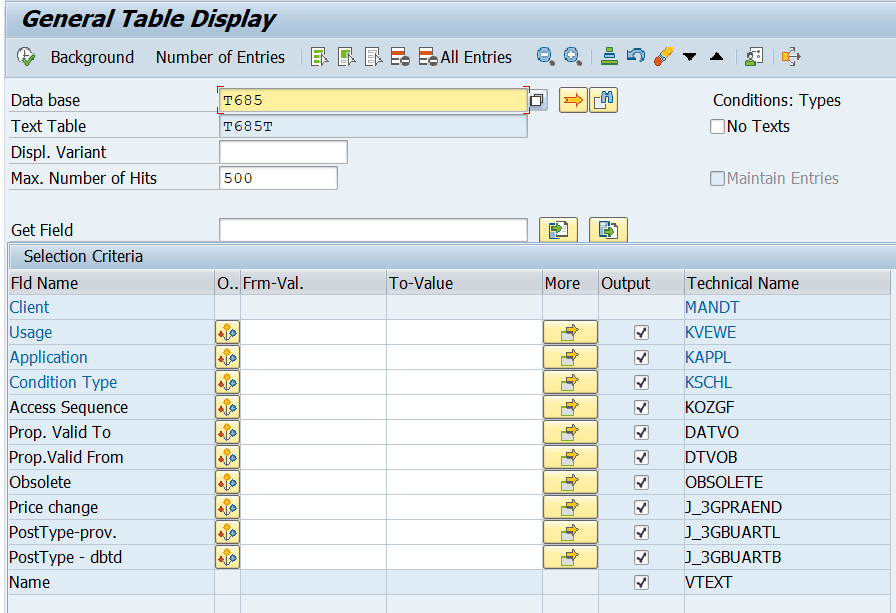
Each condition type is identified by a Condition Type Key (KSCHL) in T685 within application and usage. The access sequence (KOZGF) assigned to a condition type determines how SAP searches for application condition records. The related access sequence configuration is maintained in the T682 table, while its individual access sequence conditions are maintained in T682I.
For Example:
When a sales order is created in SAP, the system determines the applicable pricing procedure and processes the condition types assigned to that procedure.
For condition types with an access sequence, SAP find the applicable pricing condition records based on the configured access sequences. The system then calculate prices, discounts, freight charges, surcharges and taxes according to the configured rules.
Quick overview
| SAP table | T685 |
|---|---|
| Short description | Conditions: Types |
| Table type | Transparent table |
| Primary key | MANDT (Client), KVEWE (Usage of the condition table), KAPPL (Application), KSCHL (Condition Type) |
| Client-dependent | Yes |
Important fields explained
| Field | SAP field description | What this field means |
|---|---|---|
KVEWE |
Usage of the condition table | Condition usage that identifies the area in which the condition type is used. |
KAPPL |
Application | Application area in which the condition type is used. |
KSCHL |
Condition Type | Condition type that identifies a pricing condition. |
KOZGF |
Access Sequence | Access sequence assigned to the condition type. |
At a glance
- Module
- Sales and Distribution SD
- Application component
- MASTER DATA SD-MD
- Subcomponent
- CONDITIONS SD-MD-CM
Technical details
- Delivery class
- C (Customizing, maintenance only by customer, no SAP imports)
- Data class
- APPL2 (Organization and customizing)
- Package
- Application development Conditions (VKON)
Primary key fields
| Field | Description | Data element | Type | Length |
|---|---|---|---|---|
MANDT
|
Client | MANDT | CLNT | 3 |
KVEWE
|
Usage of the condition table | KVEWE | CHAR | 1 |
KAPPL
|
Application | KAPPL | CHAR | 2 |
KSCHL
|
Condition Type | KSCHL | CHAR | 4 |
Table fields
11 fields
11 fields
| Field | Description | Data element | Domain | Type | Length | Decimals | Check table |
|---|---|---|---|---|---|---|---|
MANDT
Key
|
Client | MANDT | MANDT | CLNT | 3 | — | T000 |
KVEWE
Key
|
Usage of the condition table | KVEWE | KVEWE | CHAR | 1 | — | T681V |
KAPPL
Key
|
Application | KAPPL | KAPPL | CHAR | 2 | — | T681Z |
KSCHL
Key
|
Condition Type | KSCHL | KSCHL | CHAR | 4 | — | |
KOZGF
|
Access Sequence | KOZGF | KOZGF | CHAR | 4 | — | T682 |
DATVO
|
Proposed End Date for the Validity Period | DATVO | DATVO | CHAR | 1 | — | |
DTVOB
|
Proposed Start Date for the Validity Period | DTVOB | DTVOB | CHAR | 1 | — | |
OBSOLETE
|
Restriction of Maintainability of Condition Records | K_OBSOLETE | K_OBSOLETE | CHAR | 1 | — | |
J_3GPRAEND
|
Take Price Change Over Time Into Account | J_3GPRAEND | X | CHAR | 1 | — | |
J_3GBUARTL
|
Posting Type - Providing Party | J_3GBUARTL | J_3GBUART | NUMC | 1 | — | |
J_3GBUARTB
|
Posting Type - Debited Party | J_3GBUARTB | J_3GBUART | NUMC | 1 | — |
No fields match the selected filters.
Editorial and verification
- Content editor
- ERPSAP Content Team
- Technical reviewer
- ERPSAP Technical Review Team
- Verified against
- SAP S/4HANA 2023 On-Premise system
- Last updated
- October 12, 2026
The information on this SAP T685 table page is based on the verified SAP S/4HANA 2023 on-premise system identified above. Table definitions, fields, and availability may differ across SAP releases and customer-specific systems.