
SAP Table KONP
Conditions (Item)
What Is the SAP KONP Table?
SAP KONP Table is used to store condition record item data in SAP. It contains details pricing information maintained for condition records.
In SAP Sales and Distribution (SD), condition records are maintained to determine prices, discount, surcharges, freight charges, and taxes during sales transactions,
The KONP table contains important information such as Condition Record Number, Condition type, Calculation type, Pricing Unit, and Unit of Measure.
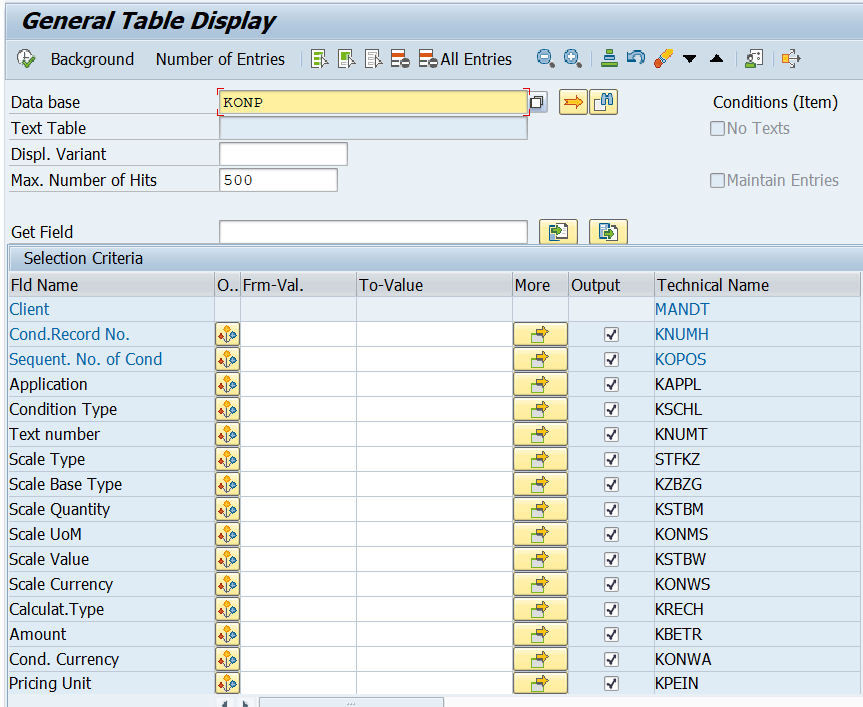
Each condition record item is linked to its corresponding condition header in KONH table through a condition record number (KNUMH)
When a sales order is created in SAP, it uses pricing information maintained in the condition records and determine the applicable prices based on the configured pricing procedure, condition types, access sequences and validity period.
Quick overview
| SAP table | KONP |
|---|---|
| Short description | Conditions (Item) |
| Table type | Transparent table |
| Primary key | MANDT (Client), KNUMH (Number of Condition Record), KOPOS (Sequential number of the condition) |
| Client-dependent | Yes |
Important fields explained
| Field | SAP field description | What this field means |
|---|---|---|
KNUMH |
Number of Condition Record | Condition record number that links the item in KONP to its header in KONH. |
KOPOS |
Sequential number of the condition | Item number within the condition record. |
KAPPL |
Application | Application area in which the condition record is used. |
KSCHL |
Condition Type | Condition type associated with the condition item. |
At a glance
- Module
- Sales and Distribution SD
- Application component
- MASTER DATA SD-MD
- Subcomponent
- CONDITIONS SD-MD-CM
Technical details
- Delivery class
- A (Application table: master and transaction data)
- Data class
- APPL0 (Master Data, Transparent Tables)
- Package
- Application development Conditions (VKON)
Primary key fields
| Field | Description | Data element | Type | Length |
|---|---|---|---|---|
MANDT
|
Client | MANDT | CLNT | 3 |
KNUMH
|
Number of Condition Record | KNUMH | CHAR | 10 |
KOPOS
|
Sequential number of the condition | KOPOS | NUMC | 2 |
Table fields
62 fields
62 fields
| Field | Description | Data element | Domain | Type | Length | Decimals | Check table |
|---|---|---|---|---|---|---|---|
MANDT
Key
|
Client | MANDT | MANDT | CLNT | 3 | — | T000 |
KNUMH
Key
|
Number of Condition Record | KNUMH | KNUMH | CHAR | 10 | — | |
KOPOS
Key
|
Sequential number of the condition | KOPOS | NUM02 | NUMC | 2 | — | |
KAPPL
|
Application | KAPPL | KAPPL | CHAR | 2 | — | T681A |
KSCHL
|
Condition Type | KSCHA | KSCHL | CHAR | 4 | — | T685 |
KNUMT
|
Number of texts | KNUMT | KNUMB | CHAR | 10 | — | |
STFKZ
|
Scale Type | STFKZ | STFKZ | CHAR | 1 | — | |
KZBZG
|
Scale Base Type | KZBZG | KZBZG | CHAR | 1 | — | |
KSTBM
|
Condition Scale Quantity | KSTBM | MENG15 | QUAN | 15 | 3 | |
KONMS
|
Condition Scale Unit of Measure | KONMS | MEINS | UNIT | 3 | — | T006 |
KSTBW
|
Scale Value | KSTBW | WERT8 | CURR | 15 | 2 | |
KONWS
|
Scale Currency | KONWS | WAERS | CUKY | 5 | — | TCURC |
KRECH
|
Calculation Type for Condition | KRECH | KRECH | CHAR | 1 | — | |
KBETR
|
Condition amount or percentage where no scale exists | KBETR_KOND | WERTV6 | CURR | 11 | 2 | |
KONWA
|
Condition Unit (Currency or Percentage) | KONWA | WAERS | CUKY | 5 | — | TCURC |
KPEIN
|
Condition Pricing Unit | KPEIN | KPEIN | DEC | 5 | 0 | |
KMEIN
|
Condition Unit | KMEIN | MEINS | UNIT | 3 | — | T006 |
PRSCH
|
Scale Group | SCLGR | CHAR4 | CHAR | 4 | — | |
KUMZA
|
Numerator for converting condition units to base units | KUMZA | UMBSZ | DEC | 5 | 0 | |
KUMNE
|
Denominator for converting condition units to base units | KUMNE | UMBSN | DEC | 5 | 0 | |
MEINS
|
Base Unit of Measure | MEINS | MEINS | UNIT | 3 | — | T006 |
MXWRT
|
Lower limit of the condition rate/amount | MXWRT | WERTV6 | CURR | 11 | 2 | |
GKWRT
|
Upper limit for the condition rate | GKWRT | WERTV6 | CURR | 11 | 2 | |
PKWRT
|
Planned condition value | PKWRT | WERTV8 | CURR | 15 | 2 | |
FKWRT
|
Cumulative guaranteed discount (not used) | FKWRT | WERTV8 | CURR | 15 | 2 | |
RSWRT
|
Accumulated accruals values (not used) | RSWRT | WERTV8 | CURR | 15 | 2 | |
KWAEH
|
Condition Currency (for Cumulation Fields) | KWAEH | WAERS | CUKY | 5 | — | TCURC |
UKBAS
|
Planned condition basis | UKBAS | WERTV8 | CURR | 15 | 2 | |
KZNEP
|
Condition exclusion indicator | KZNEP | KZNEP | CHAR | 1 | — | T686A |
KUNNR
|
Customer Number | KUNNR | KUNNR | CHAR | 10 | — | KNA1 |
LIFNR
|
Account Number of Supplier | LIFNR | LIFNR | CHAR | 10 | — | LFA1 |
MWSK1
|
Tax on sales/purchases code | MWSKZ | MWSKZ | CHAR | 2 | — | |
LOEVM_KO
|
Deletion Indicator for Condition Record | LOEVM_KO | XFELD | CHAR | 1 | — | |
ZAEHK_IND
|
Condition item index | DZAEHK_IND | ZAEHK | NUMC | 3 | — | |
BOMAT
|
Material for rebate settlement | BOMAT | MATNR | CHAR | 40 | — | MARA |
KBRUE
|
Accrual Amount | KBRUE | WERTV6 | CURR | 11 | 2 | |
KSPAE
|
Rebate was set up retroactively | KSPAE | XFELD | CHAR | 1 | — | |
BOSTA
|
Condition Record Status (Rebate) | BOSTA_CR | BOSTA_CR | CHAR | 1 | — | |
KNUMA_PI
|
Promotion | KNUMA_PI | KNUMA | CHAR | 10 | — | KONA |
KNUMA_AG
|
Sales Deal | KNUMA_AG | KNUMA | CHAR | 10 | — | KONA |
KNUMA_SQ
|
Sales quote | KNUMA_SQ | KNUMA | CHAR | 10 | — | KONA |
VALTG
|
Additional Value Days | VALTG | TAGE2 | NUMC | 2 | — | |
VALDT
|
Fixed Value Date | VALDT | DATUM | DATS | 8 | — | |
ZTERM
|
Terms of Payment Key | DZTERM | ZTERM | CHAR | 4 | — | |
ANZAUF
|
Maximum number of sales orders per condition record | ANZAUF | ANZAUF | NUMC | 2 | — | |
MIKBAS
|
Minimum condition base value | MIKBAS | MENG15 | QUAN | 15 | 3 | |
MXKBAS
|
Maximum condition base value | MXKBAS | MENG15 | QUAN | 15 | 3 | |
KOMXWRT
|
Maximum condition value | KOMXWRT | WERTV7 | CURR | 13 | 2 | |
KLF_STG
|
Number of incremental scale | KLF_STG | KLFNR | NUMC | 4 | — | |
KLF_KAL
|
Scale number for pricing | KLF_KAL | KLFNR | NUMC | 4 | — | |
VKKAL
|
Sales Price Calculation: Relevant to Pricing | VKKAL | XFELD | CHAR | 1 | — | |
AKTNR
|
Retail Promotion | WAKTION | WAKTION | CHAR | 10 | — | |
KNUMA_BO
|
Agreement (subsequent settlement) | KNUMA_BO | KNUMA | CHAR | 10 | — | KONA |
MWSK2
|
Withholding Tax Code | WT_WITHCD | WT_WITHCD | CHAR | 2 | — | |
VERTT
|
Contract Type | RANTYP | RANTYP | CHAR | 1 | — | |
VERTN
|
Contract Number | RANL | RANL | CHAR | 13 | — | |
VBEWA
|
Flow Type | SBEWART | SBEWART | CHAR | 4 | — | TZB0A |
MDFLG
|
Indicator: Matrix Maintenance | MDFLG | MDFLG | CHAR | 1 | — | |
KFRST
|
Release Status | KFRST | KFRST | CHAR | 1 | — | |
UASTA
|
Status of business volume comparison for a condition | UASTA | UASTA | CHAR | 1 | — | |
CNDN_CHGREASON
|
Reason for Changing Condition Record | CNDN_CHGREASON | CNDN_CHGREASON | CHAR | 3 | — | CNDN_CHG_REASON |
CMMDTYPRCGCNDNFMLAUUID
|
CPE Caller - GUID of Document Item Condition | CPET_DOCITEMCOND_GUID | SYSUUID | RAW | 16 | — |
No fields match the selected filters.
Editorial and verification
- Content editor
- ERPSAP Content Team
- Technical reviewer
- ERPSAP Technical Review Team
- Verified against
- SAP S/4HANA 2023 On-Premise system
- Last updated
- October 11, 2026
The information on this SAP KONP table page is based on the verified SAP S/4HANA 2023 on-premise system identified above. Table definitions, fields, and availability may differ across SAP releases and customer-specific systems.